Education
•
9 minute read
Share Article

Table of Contents
Mass payout efficiency in 2026 is determined by three technical variables: account initialization overhead, priority fee management, and issuer-level compliance agility. For operations exceeding 10,000 transactions, the choice of network directly impacts the bottom line through "hidden" costs like storage rent and energy burning.
Best chain by use case
In 2026, mass payout efficiency is no longer just about gas fees – it is about Account Setup Costs and Resource Management. Choosing the wrong network for a new recipient list can increase your overhead by up to 500%.
Use case | Best chain | Primary advantage |
|---|---|---|
B2B payroll | TRON | Deep USDT liquidity + predictable costs via energy rental. |
Mass withdrawals | BSC | Full EVM compatibility with zero "Account Activation" fees. |
Loyalty rewards | Solana | Lowest sub-cent fees for high-frequency, small-value transfers. |
Social airdrops | TON | Direct Telegram integration for massive, one-time viral reach. |
Best pick by priority: cost / reliability / freeze risk
If your business operation is driven by a single critical factor, follow these 2026 engineering standards:
Lowest total cost: Solana (via ZK-Compression)
Sending to 10,000+ new users traditionally costs ~$4,000 in ATA (Account Rent) fees. In 2026, ZK-compression allows you to "compress" these accounts, reducing initialization costs by 95% while keeping transaction fees at a fraction of a cent.
Highest reliability: TRON
For mission-critical B2B settlements where "it must arrive now," TRON is the industrial gold standard. While other networks face "Retry Pain" during peak loads, TRON’s deterministic finality and the ability to buy energy upfront ensure your USDT flow is never interrupted.
Lowest freeze exposure: BSC (Multi-Asset)
USDT on TRON is the primary focus of global regulators. BSC offers a more diversified stablecoin ecosystem. By splitting payouts between USDT, USDC, and decentralized stables, you reduce the risk of a single "Issuer Freeze" halting your entire treasury.
What “mass payouts” means in 2026
Comparing "average fees" for a single transaction is useless. A mass payout is an infrastructure task where efficiency is destroyed by hidden activation taxes and network retries. If you send 10,000 payments without calculating the Total Destination Cost (TDC), you risk overpaying by thousands of dollars due to uninitialized recipient wallets. Efficiency now means managing Energy Markets, Account Rent, and State Compression.
The 3 metrics that matter
Total destination cost (TDC): The real price = Network Fee + Account Setup Fee. Setup fees for new users are often 10x higher than the transfer itself.
Operational reliability: You need deterministic finality. If a batch of 5,000 transactions drops during a market spike, the cost of manual reconciliation outweighs any fee savings.
Freeze risk: The vulnerability of your treasury to USDT/USDC issuer-level blacklisting. Automated AML monitoring is now standard; your choice of network determines how easily a "dirty" recipient can trigger a freeze on your entire distribution wallet.
Existing vs. new recipients (the biggest cost driver)
Your 2026 payout budget is determined by whether your recipients already hold the token. "Cold" wallets (new users) are the primary source of budget leakage.
TRON: the Energy rental strategy
Sending USDT/TRC20 to a wallet that doesn't hold USDT requires ~130,000 Energy — nearly double the ~65,000 needed for active wallets. The fix: use Energy rental. By renting energy instead of burning TRX, you can cut transaction fees by up to 70% and significantly reduce the cost of sending to first-time recipients.
Good to know: a completely fresh TRON address requires a one-time activation of 1 TRX to become visible on the network — without it, the address exists but tokens won't appear on-chain.
Solana: the rent-exempt barrier
Every new recipient requires an Associated Token Account (ATA) costing ~0.002 SOL (~$0.40) in rent. 10k new users equals $4,000 upfront. The 2026 Solution: Professional airdrops use ZK-Compression. This technology "compresses" account data, reducing the $4,000 setup cost for 10k users to less than $100.
BSC (BNB Chain): the no-activation winner
BSC remains the only major chain with $0 activation fees. Sending to a brand-new address costs exactly the same as an old one. This makes BSC/opBNB the most cost-effective for "one-time" mass withdrawals to rotating lists of fresh wallets.
Cost comparison (10k payout baseline)
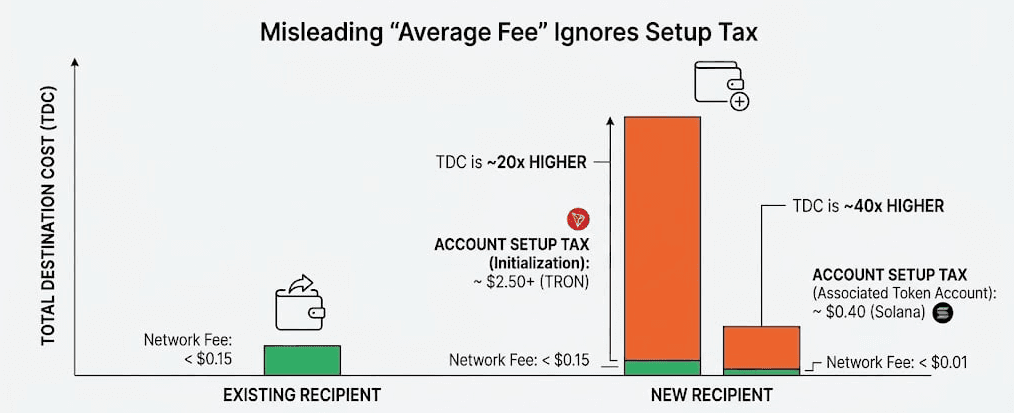
For business operations in 2026, the cost of mass payouts is defined by the recipient's wallet state. A simple "average fee" calculation is misleading because it ignores the Setup Tax for new users.
Network | 10k payouts (existing) | 10k payouts (new) | Cost driver |
|---|---|---|---|
TRON (USDT) | ~$1,200 | ~$2,500+ | Energy Rental vs. Activation |
BSC (USDC/USD1) | $0* | $0* | 0-Fee Carnival Sponsorship |
Solana (USDC) | ~$10 | ~$4,000 | ATA Rent-Exempt Deposit |
TON (USDT) | ~$500 | ~$800 | Cell Storage & Sharding |
*BSC costs assume active sponsorship programs (e.g., 2026 Carnival). Standard non-sponsored fees are ~$1,000 per 10k transfers.
Reliability at scale: what breaks during bulk runs
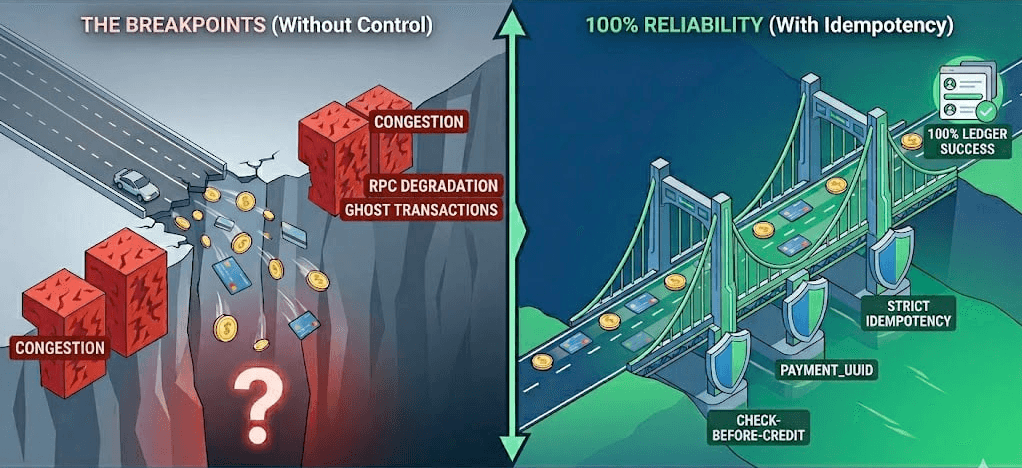
In 2026, the real cost of a mass payout isn't the gas – it's the Engineering Overhead from failed transactions. When broadcasting 10,000+ payments, you are fighting RPC Degradation, Mempool Congestion, and Finality Lag. If a network has a 1% failure rate during peak loads, reconciling 100 "ghost" transactions costs more than the gas for the entire batch.
Reliability scorecard: finality, congestion & retry pain
Metric | TRON | Solana | BSC / opBNB | TON |
|---|---|---|---|---|
Finality Time | ~12.8s (Steady) | <400ms (Soft) | ~1.1s (Fast) | ~6s (Async) |
Congestion Risk | Very Low | Low (Post-Firedancer) | Moderate | Lowest |
Retry Pain Score | 1/10 | 2/10 | 4/10 | 6/10 |
TRON: the industrial machine
The most predictable rail. If you have the Energy, your transaction enters the next block without "gas wars."Solana: post-firedancer performance
100k+ TPS capacity makes your payout batch "noise" to the network. Local Fee Markets ensure a viral NFT mint doesn't increase the cost of your USDC payouts.TON: asynchronous complexity
Infinite sharding prevents halts, but the asynchronous nature means a "success" at the sender level doesn't mean the "Cell" updated at the destination instantly.
The #1 Operational Rule: Idempotency + Reconciliation
When scaling payouts in 2026, your infrastructure must be built for the inevitability of network failures.
Strict Idempotency
Assign a unique Payment_UUID to every payout in your database before the broadcast starts and use this as your Idempotency Key. If your signing script crashes, the system must check the blockchain for that specific UUID upon restart. If the UUID is already associated with a hash, the system skips the broadcast. This ensures you never send funds twice.
Sequence Integrity (Nonce Management)
TRON / BSC (EVM): Use a Sequential Nonce Manager. If transaction #50 hangs, stop the queue. Forcing #51 triggers a "Nonce Gap" error that blocks your entire pipeline.
Solana: Implement Durable Nonces. Standard transactions expire in ~90 seconds. Durable nonces allow you to sign transactions that remain valid indefinitely, which is critical during massive network spikes.
The "Check-Before-Credit" Pattern
Never trust a "Broadcast Success" message. Execute the broadcast and log the hash immediately. Use a separate Watchdog Service to poll the RPC for that hash. Only mark the payout as "Success" in your ledger when the network returns a Finalized (Solana) or Confirmed (TRON) status.
Run Simulated Transactions via TRON or Solana APIs before a real batch. This performs a "dry run" of 10,000 transactions for $0, catching Account Not Initialized or Insufficient Energy errors before you burn real gas.
Decision Matrix: 2026 Chain Selection
Payout efficiency depends on matching your business profile to network architecture.
Recommendations by Scenario
BSC for withdrawals (exchanges): Zero account activation fees and the 0-Fee Carnival make it the cheapest entry point for "cold" wallets and rotating user lists.
TRON for payroll (B2B): Deepest USDT liquidity and industrial stability. Use Energy Rental (via StashTRX) to lock in predictable ~$0.12 fees for recurring payouts.
Solana for rewards (micro-tips): Sub-cent fees and Firedancer throughput ensure 10,000 transfers cost less than a cup of coffee.
TON for airdrops (marketing): Direct Telegram integration removes wallet friction, while asynchronous sharding prevents "gas wars" during million-user distributions.
Minimal Bulk-Payout Checklist
Dry-run for $0 to catch "Insufficient Energy" errors.
Filter recipients to prevent automated Issuer Freezes.
Assign a Payment_UUID to block duplicate payments on restart.
Set max priority fees to avoid volatility spikes.
Stop the queue if one transaction (e.g., #50) fails.
Credit users only after Hard Finality is confirmed.
Perform "Gap Analysis" to retry only failed hashes.
Conclusion
Success requires mastering Total Destination Cost (TDC). Use TRON for stability or Solana for speed, but always prioritize Strict Idempotency and a Check-Before-Credit workflow to ensure institutional-grade reliability during network congestion.
FAQ
Which chain is cheapest for 10k stablecoin payouts in 2026?
Solana is cheapest for existing users, but BSC wins for new wallets due to zero activation taxes. TRON offers the most predictable USDT pricing via Energy Rental.
Why do new recipients dramatically increase total cost?
New wallets trigger a "New User Tax" for account initialization. Solana requires ~$0.40 in ATA Rent, while TRON burns extra Energy for activation. These setup fees are often 10x–50x higher than the base transaction cost.
What’s the biggest freeze risk in stablecoin payouts?
The primary threat is an Issuer-Level Blacklist by Tether or Circle. Automated AML monitors can freeze your distribution wallet if a single recipient is "dirty." Pre-screen addresses and segregate your treasury from your hot wallet to isolate risk.
What causes double payments during bulk payouts?
Double-pays occur when retries lack Strict Idempotency. Without a unique Payment_UUID, script crashes or RPC drops trigger redundant broadcasts. Assign a unique ID to every payout and verify on-chain status before any retry.
Latest Release