News
•
10 minute read
Share Article

Table of Contents
On August 29, 2025 the TRON network halved the price of Energy, the resource that pays for smart-contract transactions such as USDT transfers.
The price per unit fell from 210 sun to 100 sun, and the cost of a standard USDT transfer paid by burning TRX dropped from about 13.65 TRX to about 6.5 TRX. It was the largest fee reduction in TRON’s history.
More than a year later, that decision still defines what you pay on TRON. This guide explains what Proposal #104 changed, how the vote worked, what happened after it took effect, and what TRON fees look like in 2026.
TRON’s fee-cut proposal approved: network fees slashed by 50%
TRON is known for speed and low costs, but by mid-2025 its fees had become a problem. The network charges fees in TRX, and the TRX price had roughly doubled since early 2024. As a result, the dollar cost of a USDT transfer rose sharply even though the network rules hadn’t changed.
To address this, a community member with the username GrothenDI opened a discussion titled “Decrease the transaction fees” on August 8, 2025 in the TRON Improvement Proposals repository on GitHub (issue #789). The idea was simple: lower the Energy unit price from 210 sun to 100 sun to make the network cheaper and more competitive again.

Source: https://github.com/tronprotocol/tips/issues/789
What has been proposed (and why it matters)
The proposal targets one network parameter: the Energy unit price. It determines how much TRX is burned for every unit of Energy a transaction uses when the sender doesn’t have Energy of their own. USDT transfers are by far the largest consumer of Energy on TRON, so they were the main target.
Keeping fees low matters for adoption. High costs push away new users, small merchants, and developers, especially in payments and DeFi. The proposal estimated that halving the price could add around 12 million potential users who could afford to complete a typical USDT transfer by burning TRX.
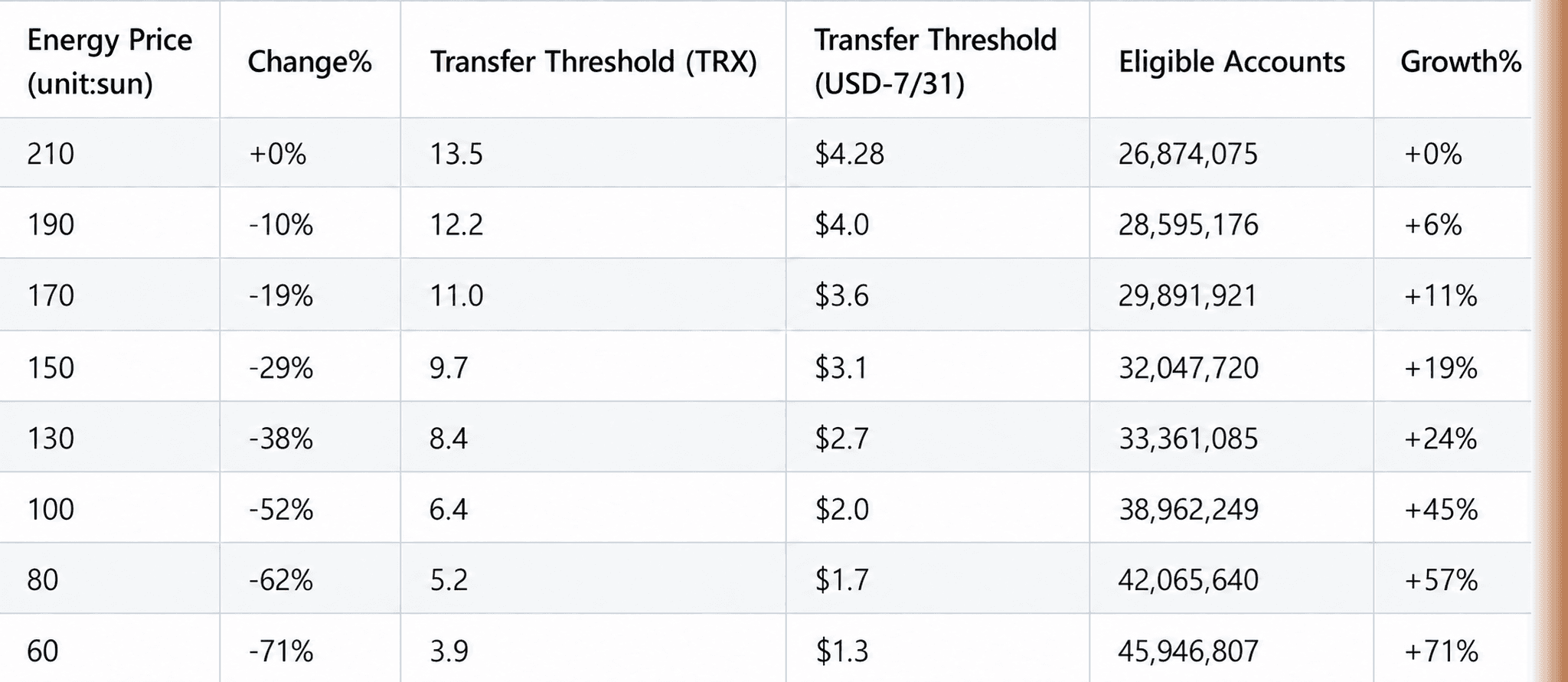
Source: https://github.com/tronprotocol/tips/issues/789
There was also a lesson from an earlier change. Proposal #95 in 2024 halved the Energy unit price too, but at the same time raised the maximum factor of TRON’s dynamic energy model, which only applies to the USDT contract. The result was that USDT transfers cost the same in TRX as before, while other contracts became cheaper. Deployments of new smart contracts rose afterwards, which the authors of Proposal #104 cited as evidence that lower fees encourage activity. This time the cut was designed to reach USDT transfers as well.

Source: https://github.com/tronprotocol/tips/issues/789
The numbers: from 210 to 100 sun
A sun is the smallest unit of TRX, named after TRON founder Justin Sun. One TRX equals 1,000,000 sun, much like one bitcoin is divided into satoshis. So an Energy price of 100 sun means that each unit of Energy costs 0.0001 TRX when it has to be paid by burning.
A standard USDT transfer to a wallet that already holds USDT uses about 65,000 Energy. At 210 sun that meant burning about 13.65 TRX. At 100 sun it costs about 6.5 TRX. Transfers to a wallet that has never held USDT use roughly twice as much Energy, so the saving there is larger in absolute terms.
Operation | Energy used | Cost at 210 sun | Cost at 100 sun |
|---|---|---|---|
USDT transfer to a wallet holding USDT | About 65,000 | About 13.65 TRX | About 6.5 TRX |
USDT transfer to a wallet with no USDT | About 131,000 | About 27.5 TRX | About 13.1 TRX |
Typical DeFi swap or contract call | About 100,000 | About 21 TRX | About 10 TRX |
These figures apply when you pay by burning TRX. If your wallet already has Energy from staking or rental, the transfer burns little or no TRX regardless of the unit price.
Why you see both 50% and 60%
You will find both numbers in the news, and both are correct. The Energy unit price fell by 52.4%, from 210 to 100 sun, which is why the change is usually called a 50% cut. The 60% figure comes from on-chain analytics firms that measured the drop in the average fee across all transactions on the network after the change. One describes the parameter, the other describes the effect on real transactions.
Governance at a glance: how the vote works
TRON uses a delegated proof-of-stake system. TRX holders vote for 27 Super Representatives (SRs), who produce blocks, validate transactions, and vote on changes to network parameters. Anyone can open a discussion about a change, but only SRs can put a proposal to an on-chain vote. To pass, a proposal needs at least 18 of the 27 votes, and every vote is visible publicly on Tronscan.
For this change, voting ran from August 26 to August 29, 2025. According to the on-chain record, 25 of the 27 SRs voted in favour, including Chain Cloud and CryptoChain, and two abstained. The new price took effect on August 29.
The two numbers you see attached to this change often confuse readers. Issue #789 is the discussion on GitHub where the idea was proposed and debated. Proposal #104 is the formal on-chain vote that changed the parameter. They refer to the same fee cut.

Source: https://tronscan.org/#/proposal/104
What Justin Sun thinks about it
TRON founder Justin Sun backed the proposal publicly and called it the largest fee cut in the network’s history. He acknowledged that lower fees would reduce short-term revenue for the network, but argued that higher adoption and transaction volume would make up for it over time.
He also said the SR community would review fees every quarter, looking at the TRX price, network activity, and growth, to keep TRON both sustainable for validators and competitive for users. His comments were shared on his X account.

Source: https://x.com/justinsuntron
What happened after the fee cut
The change took effect immediately, so its impact was visible within days. The clearest effects showed up in validator revenue and in TRON’s position among other blockchains.
Market reaction and TRX price
Market commentary at the time was cautious rather than dramatic. Some analysts worried that less TRX being burned would weaken the token over time, while others saw the cut as a necessary step to defend TRON’s role as the main network for USDT. At the time of the vote, TRON held about $81 billion in USDT, ahead of Ethereum’s roughly $74 billion, so keeping transfers cheap was about protecting that lead.
Network activity and validator revenue
The most measurable effect was on revenue. Daily fees collected by the network fell from about $13.9 million on August 28 to about $5 million by September 7, a drop of roughly 64% in ten days. Even so, TRON still generated the large majority of fees among Layer 1 blockchains during that period, according to Token Terminal data. In other words, the network became much cheaper to use without losing its place as one of the most used chains for payments.
U.S. Commerce Department puts GDP data on TRON
Around the same time, the U.S. Department of Commerce announced that it would publish official economic data, including GDP figures, on several public blockchains, with TRON among them alongside Bitcoin, Ethereum, Solana, and others. It had nothing to do with fees directly, but it added to the sense that TRON’s infrastructure was being taken seriously beyond the crypto industry.
Who benefits most from this fee drop
The fee cut makes TRON cheaper for almost everyone who uses smart contracts, but some groups benefit more than others.
Everyday users and P2P transfers
Anyone who sends USDT to friends, family, or other traders now pays roughly half as much in TRX per transfer when burning. For people who send money regularly, especially across borders, that difference adds up quickly.
Developers and DApps
Deploying contracts and interacting with applications costs less, which lowers the barrier for new projects and makes existing apps cheaper for their users. Developers who pay fees on behalf of users benefit twice.
Merchants and payment providers
TRON already carries a very large share of stablecoin payments. Lower fees make it cheaper for merchants, exchanges, and payout services to move money, which strengthens TRON’s position for business payments and remittances.
The TRON network as a whole
Cheaper transactions can reduce short-term revenue, as the data above shows. The bet is that more users and more transactions will build a stronger ecosystem in the long run.
Trade-offs and risks: burn vs. inflation
Every time TRX is burned to pay for Energy, it leaves circulation. Burning helps offset the new TRX created as block rewards, and at higher fees it had kept TRON’s supply close to deflationary. Halving the Energy price means less TRX is burned per transaction, and the proposal itself acknowledged that this would shift the on-chain supply from a deflationary trend towards an inflationary one.
Whether that matters depends on volume. If transaction numbers grow enough, total burning can recover even at the lower price. If they don’t, more TRX stays in circulation, which can weigh on the price. The fee cut is best understood as a deliberate trade-off: accepting some inflation risk in exchange for keeping the network affordable and competitive.
Practical examples: how much could you save?
Here is what the move from 210 to 100 sun means in practice for different types of users, assuming fees are paid by burning TRX.
USDT (TRC20) transfers
A USDT transfer to a wallet holding USDT went from about 13.65 TRX to about 6.5 TRX. For a business sending 100 such transfers a day, that is a saving of about 7.15 TRX per transfer, or roughly 21,000 TRX a month.
Smart contract deployment
Deploying a new contract that used to burn 200 to 300 TRX now costs roughly 100 to 150 TRX, depending on its complexity. For small teams, that noticeably lowers the cost of launching and testing a new application.
DeFi swaps & interactions
A typical swap or lending action using about 100,000 Energy went from about 21 TRX to about 10 TRX. A user making 50 such transactions a month saves around 550 TRX a month, or about 6,600 TRX a year.
NFT minting
Deploying an NFT collection contract follows the same pattern as other deployments: costs that used to reach 200 to 300 TRX now come in at roughly half. Minting individual tokens is cheaper as well, which helps projects with large collections.
TRON fees in 2026: where things stand now
At the time of this update in September 2026, the Energy unit price remains at 100 sun, the level set by Proposal #104. The quarterly reviews Justin Sun described have not produced another change to this parameter, so the costs shown in this article are still the ones you pay today when burning TRX.
Transfer | If you burn TRX | If you rent Energy from Tronex |
|---|---|---|
USDT to a wallet holding USDT | About 6.5 TRX | 4.55 TRX max |
USDT to a wallet with no USDT | About 13 TRX | 9.45 max |
The dollar cost still depends on the TRX price, so when TRX rises, transfers become more expensive in dollar terms even though the TRX amount stays the same. That was the original reason for the 2025 cut, and it is why fees remain a topic for the SR community. For a full breakdown of what every type of transfer costs, see our guide to TRC-20 fees on TRON.
How can you cut even more Tron fees
The fee cut lowered the cost of burning TRX, but burning is still the most expensive way to pay for a USDT transfer. If you send USDT regularly, there are three ways to pay less:
stake TRX to receive your own Energy, which works if you can lock a large amount for a long time;
rent Energy only when you need it, which requires no locked capital;
automate Energy top-ups for wallets that send transfers every day.
Renting is usually the simplest option. With the new price, a transfer burns about 6.5 TRX, while renting TRON Energy brings the same transfer down to 4.55 TRX. For a business sending 100 transfers a day, that difference comes to about 5,850 TRX a month. You can compare amounts and rental terms on our pricing page, and set up automatic Energy delegation for payout or deposit wallets so they never run short. To understand how Energy and Bandwidth work together, read our explainer on TRON Bandwidth and Energy.
The 2025 fee cut made TRON more affordable for everyone. Combining it with rented Energy is how regular senders keep their costs as low as possible.
FAQ about the TRON fee cut
Short answers to the most common questions about Proposal #104 and TRON fees today.
What was TRON Proposal #104?
It was the on-chain vote that lowered TRON’s Energy unit price from 210 sun to 100 sun. It was based on the discussion in GitHub issue #789 and passed with the support of 25 of 27 Super Representatives.
When did the TRON fee cut take effect?
On August 29, 2025, at the end of the voting period.
Why do some sources say 60% and others 50%?
The Energy price fell by 52.4%, usually rounded to 50%. The 60% figure describes the drop in the average fee across all transactions after the change.
Did the fee cut make USDT transfers free?
No. A USDT transfer paid by burning TRX still costs about 6.5 TRX, or about 13 TRX to a wallet with no USDT. Transfers only become close to free if your wallet has enough staked or rented Energy.
Has the TRON Energy price changed since August 2025?
Not as of September 2026. The price is still 100 sun per unit of Energy, though the SR community can change it through a new proposal at any time.
Is renting Energy still cheaper after the fee cut?
Yes. The fee cut lowered the cost of burning, but renting remains cheaper: from 4.55 TRX per standard transfer compared with about 6.5 TRX when burning.
Latest Release